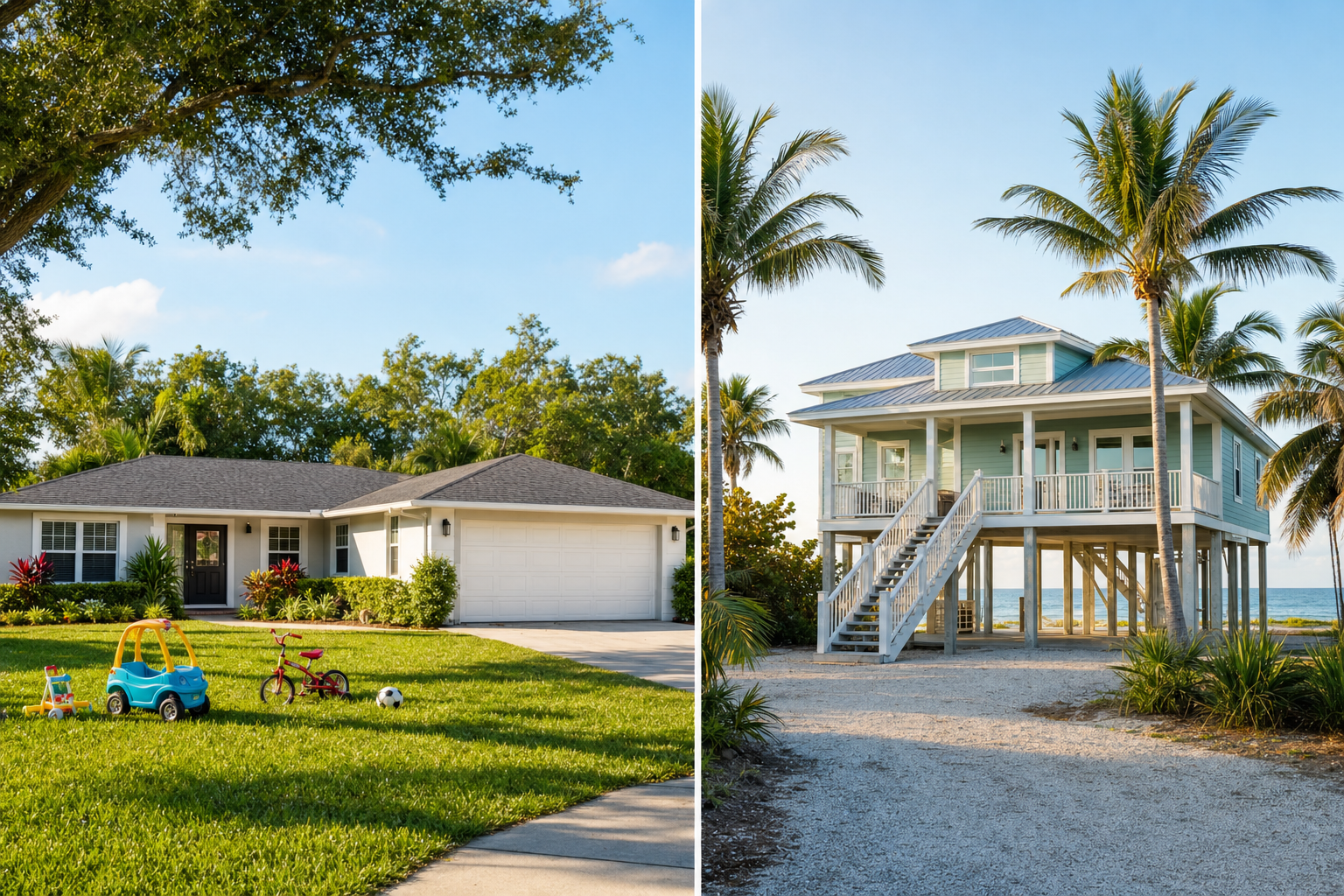
The three property classifications
Lenders, insurers, and the IRS all recognize the same three categories — and they don't overlap:
| Classification | Definition | Occupancy Rule |
|---|---|---|
| Primary residence | The home you live in most of the year | Must occupy within 60 days of closing; live there 6+ months/year |
| Second home | A vacation home for personal use | Must be available for your personal enjoyment; typically 50+ miles from primary; no long-term rental |
| Investment property | A property purchased to rent out | No personal occupancy requirement; rental income can help you qualify |
The benefits of buying as a primary residence
- Lower mortgage rates. Primary-residence rates run 0.50% – 1.00% lower than second-home or investment rates. See current rate ranges in the financing chapter.
- Lower down payments. As low as 3% conventional, 3.5% FHA, or 0% VA/USDA. Second homes start at 10% and typically require 15% – 20%.
- Florida Homestead Exemption. Up to $50,000 off your assessed value for property tax purposes, plus the Save Our Homes cap that limits annual assessed-value increases to 3% or the CPI, whichever is less.
- Capital gains exclusion. Under IRS Section 121, married couples can exclude up to $500,000 in capital gains ($250,000 single) when selling a primary residence — as long as you've lived there 2 of the last 5 years.
- Lower homeowners insurance. Primary residences get better rates than second homes because they're occupied year-round. More detail in the insurance chapter.
The benefits of buying as a second home
- Personal use of a vacation property. Use it whenever you want, avoid hotel costs, and build equity in a market you love.
- Rental flexibility. You can rent it out short-term (Airbnb, VRBO) for up to 14 days per year without reporting the income to the IRS — the "Augusta Rule."
- Appreciation in premium markets. Coastal Florida vacation homes have historically outpaced primary-residence appreciation in inland markets.
- Mortgage interest and property tax deductions. Still deductible on your second home (subject to the $750,000 combined mortgage cap and $10,000 SALT cap).
Do not tell your lender a property will be your primary residence just to get a better rate if you're really planning to rent it out. This is federal mortgage fraud. Lenders verify occupancy through utility bills, driver's license address, and even satellite imagery. Penalties include being forced to pay off the loan immediately and, in serious cases, criminal charges.
Financial comparison — $500,000 Florida home
| Category | Primary Residence | Second Home |
|---|---|---|
| Minimum down payment | 3% ($15,000) | 10% ($50,000) |
| Typical interest rate (2026) | ~6.5% | ~7.0% |
| Est. monthly principal & interest | $3,065 (on $485K) | $2,994 (on $450K) |
| Homestead property tax savings | ~$700 – $1,000/yr | Not eligible |
| Homeowners insurance | Standard rates | +20% – 30% |
Community factors that affect both
Whether it's primary or a second home, Florida-specific fees can meaningfully change your monthly cost. In many master-planned communities, CDD assessments add hundreds — sometimes thousands — per year on top of the mortgage. Read the CDD bonds chapter before you fall in love with a home in one.